
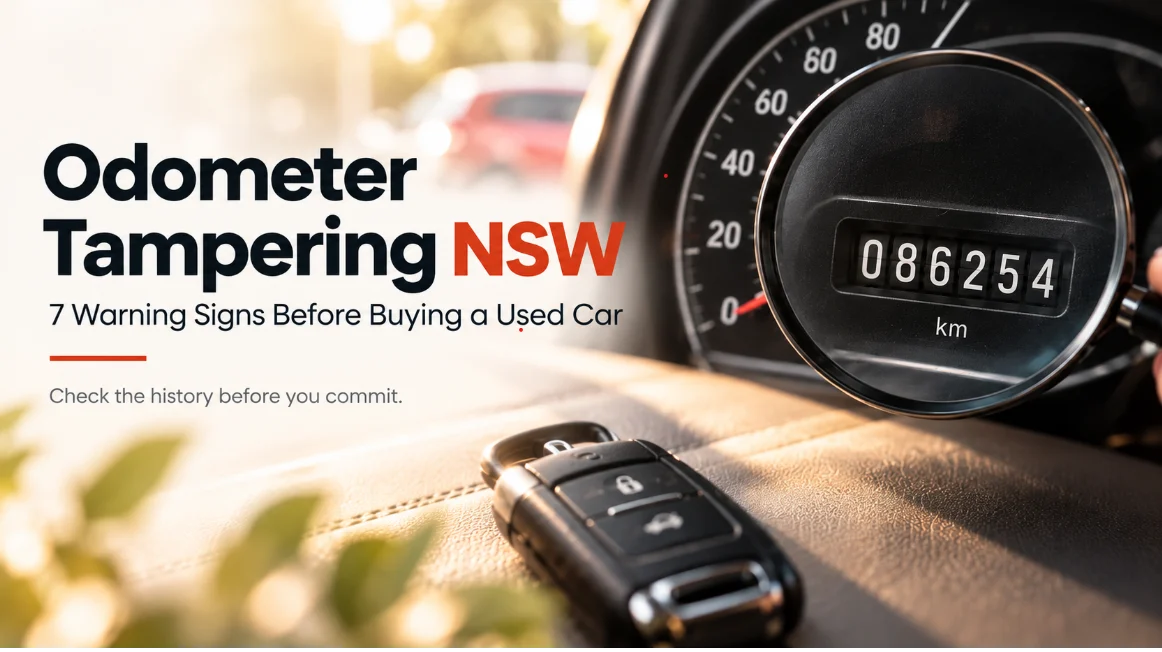
That low kilometre used car might look like a great find, but does its history actually add up? Learn how NSW buyers can check odometer records, service history, VIN details and physical clues before committing to a used car.
A low kilometre reading can make a used car look like the safer buy. The problem is that the number on the dashboard is only one piece of evidence. In NSW, buyers can check recent recorded kilometre readings for free, compare them with the car’s paperwork, and look for physical clues before paying a deposit. The goal is not to become a detective. It is to make the story of the car add up.
You find a used car in Sydney that looks clean, drives well and shows 86,000 km. The seller says it has been lightly used. The service book looks plausible. The price also makes sense for a low kilometre example.
Would you know what to check before believing the number on the dash?
Odometer tampering is illegal in NSW, but recent enforcement cases show that it still happens. In June 2026, NSW Fair Trading reported cases involving vehicles whose odometers had been reduced by roughly 160,000 km and 190,000 km. In another case, four vehicles were wound back by about 680,000 km in total, including one vehicle that went from 290,000 km to 74,000 km.
That matters for more than resale value. If the displayed kilometres are wrong, you may also be making maintenance decisions using the wrong service timeline. A car that appears to be approaching its first major service may have already passed several important maintenance intervals.
Quick answer: In NSW, start with the free Service NSW registration check and compare the three most recent yearly odometer readings, where available, with the current dashboard reading. Then check the service history, maintenance stickers, previous listings and physical wear. If anything does not make sense, treat it as a reason to investigate further rather than explaining it away.
The easiest way to check a used car is to use three layers of evidence
No single clue proves that a vehicle has been wound back. A worn steering wheel can come from city driving. A missing service stamp can be innocent. A gap in official readings can simply mean data was not recorded.
What matters is whether several independent pieces of information tell the same story.
Official history
Check the recorded odometer history, registration information and relevant vehicle history records.
Paper trail
Compare service invoices, logbook entries, maintenance stickers and previous sale records with the claimed kilometres.
Physical evidence
Look at wear, mechanical condition and anything that seems inconsistent with the age and claimed use of the car.
1. Start with the free NSW odometer history check
For a vehicle that is currently or was previously registered in NSW, a free Service NSW registration check can show the three most recent yearly odometer readings, if they are available.
You only need the NSW registration plate number. The same check also shows registration status, expiry information, restrictions or concessions, and CTP details.
The useful part is the sequence. Kilometres should normally move in one direction: up.
That drop needs an explanation before you go any further.
A lower later reading is an obvious warning sign, but subtler patterns matter too. Imagine a car that recorded 142,000 km two years ago and is now advertised at 146,000 km despite being described as a daily commuter. That is not proof of fraud, but it is a perfectly reasonable reason to ask questions and request supporting records.
Do not treat a blank odometer history as proof that the car is safe. Service NSW notes that readings may not be available. The official history is one layer of evidence, not a guarantee of the true kilometres.
Have the number plate already? Check the NSW registration and available odometer history before you spend time travelling to see the car.
Check the NSW registration history2. Make the service history tell a continuous story
A genuine service history should make sense when you read it from oldest to newest. You are not looking for a perfectly stamped book. You are looking for consistency.
Write down the kilometres from every dated service record
Start with invoices because they usually contain more detail than a stamp. Then add logbook entries and maintenance labels.
Put the records in date order
The readings should rise naturally over time. Sudden drops, duplicated stamps, unusually long gaps or records that appear out of sequence deserve a closer look.
Check who performed the work
NSW Government guidance recommends checking that service stamps include identifying details such as the provider’s name, ABN, address or phone number. If a major invoice matters to your decision, you can also ask whether the workshop can verify it.
Look beyond the logbook
Oil change labels, timing belt stickers and other maintenance labels can sometimes preserve kilometre readings that are not written anywhere else.
This step is particularly important when a car is close to a major maintenance interval. A false mileage reading can make expensive work look years away when it may already be overdue. For example, if you are buying a vehicle with an uncertain belt history, Servistar’s timing belt guide explains why evidence of previous replacement matters more than a seller’s assumption that the job was probably done.
3. Search the VIN, not just the number plate
A number plate can change. The Vehicle Identification Number is the better anchor for tracing a particular car.
NSW Government guidance specifically suggests searching the VIN online to look for previous advertisements, auction records, condition reports and odometer information. An older listing can be extremely useful if it shows the same vehicle with a higher kilometre reading than the current advertisement.
When checking a VIN, also make sure the number on the vehicle matches the paperwork. NSW guidance recommends looking for signs of interference around identifying numbers, including scratches, grind marks or drill holes.
A useful habit: Save screenshots of the current advertisement, the seller’s claimed kilometres and any history information you find. If the deal starts to feel wrong later, you have a record of what was represented before the sale.
4. Do not confuse a PPSR search with an odometer check
A PPSR search is still an important part of buying a used car, especially from a private seller. The Australian Government’s Personal Property Securities Register can tell you whether a security interest is recorded against the vehicle and may also provide information about stolen or written off status.
But the official PPSR guidance is clear about one limitation: a PPSR search does not provide the odometer reading.
Service NSW registration check
Useful for recent recorded NSW odometer readings and current registration information.
PPSR search
Useful for security interests and information such as stolen or written off status. It is not an odometer verification service.
The safer approach is to use both checks for different purposes. One does not replace the other.
5. Compare the claimed kilometres with the condition of the car
This is where buyers can easily overreact. A shiny car is not automatically low kilometre, and a worn driver’s seat does not automatically mean the odometer is false.
Instead of looking for one dramatic clue, look for a pattern.
| What to inspect | What may be worth questioning | Why it is not proof by itself |
|---|---|---|
| Pedal rubbers | Heavy wear on a car claimed to have travelled very little | Driving style and frequent short trips can accelerate wear |
| Driver’s seat and steering wheel | Noticeable wear that seems out of proportion with the claimed use | Materials age differently and previous owners may be hard on interiors |
| Switches and controls | Very polished or heavily worn high touch areas | City driving can create lots of use without huge kilometres |
| Tyres | Tyre age or replacement history that does not fit the seller’s story | Tyres can be replaced because of age, punctures or damage |
| Under bonnet labels | Old service labels showing kilometres higher than the dash | A label may belong to an old component or contain a recording error, so verify it |
NSW Government advice also recommends checking pedal wear and other signs of wear against the displayed kilometres. The point is not to estimate mileage from a steering wheel. It is to notice when the physical condition conflicts with the documentary story.
6. Be careful with explanations for a changed instrument cluster
There are legitimate reasons an instrument cluster or odometer may need repair or replacement. A failure, electrical issue or damaged display can make replacement necessary.
That does not mean you should ignore a mileage discrepancy.
If the seller says the cluster has been replaced, ask for documentation showing what happened, when it happened, the kilometre reading at the time, and who carried out the work. Current NSW rules restrict odometer alteration and replacement, and licensed repairers have notification obligations when repairing or replacing an odometer.
“The cluster was changed, so nobody knows the real kilometres.”
That explanation should lead to more questions, not fewer. A legitimate repair should have a documentary trail. If the true distance cannot be supported and the price depends heavily on the displayed kilometres, factor that uncertainty into your decision.
7. A pink slip is not a pre purchase inspection
This distinction matters in NSW. A registration safety check is not designed to answer every question a buyer has about a used car’s history, condition or future repair costs.
If you are about to spend thousands of dollars, an independent inspection can add a different kind of evidence. A mechanic may be able to identify wear, maintenance issues, fault codes, leaks, previous repairs or condition that does not fit the seller’s description.
An inspection also helps with a separate question that mileage history alone cannot answer: is this particular car in good condition today?
If you are buying around Sydney’s Northern Beaches, Servistar’s pre purchase inspection guide for Brookvale and the Northern Beaches shows what a useful inspection should cover, what to ask before booking, and when a seller’s behaviour is a reason to slow down.
A genuine 85,000 km car can still be neglected. A well maintained 160,000 km car can sometimes be the better purchase. Mileage matters, but condition and history matter with it.
8. Private sale? Slow the transaction down before you pay
Private sales can offer good value, but NSW Government guidance makes an important point: buyers have fewer protections than they may have when purchasing from a licensed dealer, and resolving a private sale dispute can be difficult.
Before transferring a deposit or full payment, make sure you have enough information to answer these questions:
- Does the current odometer reading fit the Service NSW history?
- Do the logbook and invoices show a believable progression of kilometres?
- Does the VIN on the car match the documents?
- Have you searched the VIN for previous advertisements or auction records?
- Have you completed a PPSR search close to the time of purchase?
- Does the condition of the vehicle broadly match its age, use and claimed kilometres?
- If there is a discrepancy, has the seller provided evidence rather than only an explanation?
- If the purchase is significant, has an independent mechanic inspected the car?
Pressure is information too. If a seller will not provide the VIN, discourages an independent inspection, refuses to let you verify records, or pushes for immediate payment because another buyer is supposedly waiting, you do not have to solve the mystery. You can simply walk away.
What if the mileage history does not add up?
Do not accuse the seller on the spot. First, confirm that you are comparing the correct vehicle and correct records. Simple data entry errors and legitimate repairs can happen.
Ask the seller to explain the discrepancy and provide supporting documents. If the explanation does not resolve it, pause the purchase.
If you suspect odometer tampering in NSW, Service NSW provides an online process to report suspected odometer tampering to NSW Fair Trading.
NSW Government guidance states that odometer tampering can attract a $5,500 penalty notice or prosecution with a maximum penalty of $55,000 for each instance.
Why this deserves attention in NSW right now
Odometer fraud is not only an old mechanical dashboard trick. NSW Fair Trading continues to investigate modern cases involving online marketplaces, false logbooks and substantial kilometre reductions.
In March 2026, the NSW Government reported that consumers had been awarded more than $125,000 in compensation after investigations into 10 vehicles whose odometers had collectively been wound back by about two million kilometres. One Toyota Prado was reported as being purchased with 397,000 km and later sold with 107,000 km displayed.
That is why the most useful habit for buyers is not memorising a list of scam signs. It is learning to verify a vehicle using independent sources before the emotion of the purchase takes over.
Found a car you like? Verify the car, not just the advertisement.
History checks can tell you a lot, but they cannot tell you everything about the mechanical condition of the vehicle. If you want another set of eyes on a used car before committing, Servistar helps drivers compare available service options and connect with participating mechanics and workshops.
Start a service requestA five minute check before you leave home
If you are going to inspect a used car in Sydney or elsewhere in NSW, do these checks before you get emotionally attached to it:
- Ask for the NSW registration number and VIN.
- Run the free Service NSW registration check.
- Write down the recorded odometer readings.
- Run a PPSR search using the VIN close to the purchase date.
- Search the VIN online for older advertisements or auction records.
- Ask the seller to have service invoices and the logbook ready.
Then, when you see the car, compare the paperwork with the dashboard and the car itself.
If the story is consistent, great. If it is not, you have found the problem before it became yours.
Frequently asked questions
Can I check a car’s odometer history for free in NSW?
Yes. A free Service NSW registration check can show the three most recent yearly odometer readings for vehicles previously or currently registered in NSW, where readings are available.
Does a PPSR check show the odometer reading?
No. The Australian Government PPSR states that odometer readings are not included in a PPSR search. Use PPSR for issues such as registered security interests and available stolen or written off information, and use NSW registration history and other records to investigate kilometres.
Can digital odometers be wound back?
Digital dashboards do not make mileage fraud impossible. Modern cases investigated in NSW show that buyers should still verify the history rather than assuming a digital display must be accurate.
What is the biggest warning sign of odometer tampering?
A recorded kilometre reading that is higher than a later reading is a major warning sign. Other concerns include inconsistent service records, unexplained cluster replacement, old listings showing higher kilometres, or physical condition that does not fit the claimed use.
Is low mileage always better when buying a used car?
No. Kilometres are only one part of the decision. Maintenance history, age, type of use, accident history, mechanical condition and upcoming repairs can matter just as much. A higher kilometre car with strong records may be a better purchase than a neglected low kilometre car.
What should I do if I suspect the odometer has been wound back?
Pause the purchase, verify the records and ask for supporting documents. If you still suspect tampering, you can report it to NSW Fair Trading through Service NSW.
Information checked against Service NSW, NSW Government, NSW Fair Trading and the Australian Government PPSR in September 2026. Vehicle records can be incomplete, and an odometer history check is not a substitute for an independent mechanical inspection.