
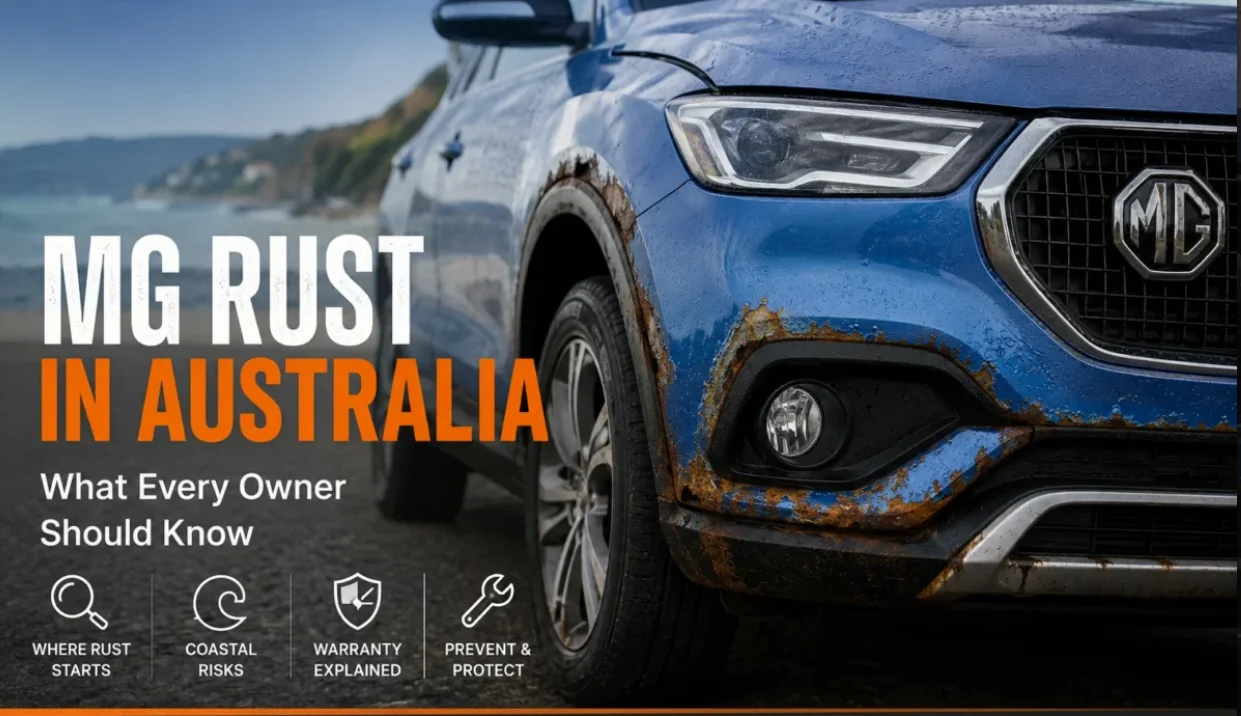
Worried about MG rust in Australia? Learn what corrosion signs to check, how coastal driving affects your MG, and what the warranty may cover.
You look underneath your MG and notice something orange. Maybe it’s around a bolt. Maybe a seam looks rough. Or you’ve just seen another owner talking about rust online and now you’re wondering whether you should be worried too.
That’s usually when the internet becomes less helpful. One photo says “normal surface rust”. Another says “warranty claim”. Someone else tells you the whole car is doomed.
The useful answer sits somewhere in the middle.
Rust can appear on vehicles from many brands, especially where exposed metal meets moisture, damaged coatings or salty conditions. There have also been recent discussions about corrosion involving MG vehicles in Australia and overseas. But that is not the same thing as saying every MG has a rust problem.
What matters is where the corrosion is, what type it is, how quickly it appears to be developing and what your particular MG warranty actually covers.
So, do MG cars rust?
Yes, an MG can develop rust. So can a Toyota, Ford, Mazda, Hyundai or almost any other vehicle containing exposed or coated steel.
The more useful question is whether the corrosion you’re looking at is ordinary surface oxidation, something that needs repairing, or something more significant.
There isn’t enough basis to simply label every MG3, MG4, ZS, HS or other MG sold in Australia as having a corrosion defect. Individual cars can have very different histories. One may have spent its life garaged inland. Another may have lived metres from the ocean, collected stone chips, driven through sand and salt spray, or previously had body repairs.
Why are Australian MG owners talking about corrosion now?
Part of the renewed interest comes from a recent Australian consumer case involving a 2021 MG ZS.
In a consumer Q&A published in July 2026, the owner said an MG dealer had identified extensive corrosion, considered the vehicle uneconomical or unsuitable to repair, and that discussions with MG Australia then turned to the remedy available under the vehicle’s warranty.
It’s an interesting case because it raises questions many owners have probably never thought about. What exactly is an anti-perforation warranty? Does it cover surface rust? What records should you keep? And what happens if the vehicle was bought used?
But one owner’s experience should not be turned into a conclusion about every MG on Australian roads. It’s better treated as a reminder to understand your own vehicle and warranty before you need them.
That is the Servistar approach to this topic
No panic. No pretending every orange mark is harmless either. Look at the car, document what you see and work out what the evidence actually tells you.
Surface rust, corrosion and perforation are not the same thing
This is where a lot of online conversations get tangled.
Surface corrosion
This can appear as orange or brown colouring on exposed metal. Depending on the component and severity, it may be mostly superficial. Exposed fasteners and some underbody parts can look less pretty than the painted panels above them without automatically being unsafe.
Scaling or flaking corrosion
When corrosion begins producing heavier scale, flaking material or visible deterioration of the metal, it deserves more attention. Location matters enormously. Deterioration on a replaceable bracket is a different question from corrosion affecting a structural area or important mounting point.
Perforation
Perforation generally means corrosion has progressed through a body panel rather than merely appearing on its surface. That distinction is particularly important when reading MG’s warranty terms.
What does MG Australia’s rust warranty actually cover?
This is the part worth reading carefully rather than relying on what someone remembers from a Facebook comment.
MG Australia’s current warranty information lists Anti-Perforation and Paint as a limited warranty. For passenger vehicles under the current policy, the listed anti-perforation and paint period is seven years.
MG describes the anti-perforation element as covering rust-through corrosion of painted metal body panels from the inside or underside when it results from a manufacturing defect during the original manufacturing process.
That wording is important because an anti-perforation warranty is not simply a promise that no orange corrosion will ever appear anywhere underneath the car.
MG’s current terms also exclude certain surface corrosion and other deterioration where factors such as improper maintenance, impact damage or environmental conditions have caused or contributed to the problem.
You can read the current MG Australia warranty terms here.
Living near the beach? MG gives surprisingly specific advice
This is particularly relevant if your MG lives on Sydney’s Northern Beaches.
Manly, Freshwater, Curl Curl, Dee Why, Collaroy, Narrabeen, Newport and the suburbs further north are brilliant places to own a car if you like an ocean view. The car itself gets the less glamorous side of the arrangement: moisture, airborne salt, beach sand and occasionally direct sea spray.
MG Australia’s own maintenance guidance specifically addresses harsh and coastal environments. It recommends cleaning areas such as the wheel arches, sills and underbody where salt, sand and dirt can collect, repairing paint chips promptly and inspecting vulnerable areas regularly.
MG even publishes different suggested care frequencies based on distance from the coast:
| Distance from coast | Fresh-water rinse | Full wash | Wax / sealant | Undercarriage wash |
|---|---|---|---|---|
| 0–1 km Beachfront |
2–3 times per week | Every 2 weeks | Every 6–8 weeks | Every 3–6 months |
| 1–5 km Near coast |
Weekly | Every 3–4 weeks | Every 10–12 weeks | Twice a year |
| 5+ km Inland |
Optional weekly | Monthly | Every 12 weeks | Yearly |
The frequencies above summarise MG Australia’s published paint and underbody care guidance current at the time of writing. Always check MG’s latest recommendations for your vehicle.
That doesn’t mean an MG parked in Manly is destined to rust. It means the manufacturer itself recognises that coastal exposure changes the care conversation.
We have covered the wider effect of salt air, short local trips and beachside parking in our Northern Beaches coastal car-care guide .
The 60-second MG rust check
You do not need a hoist in the driveway and you definitely do not need to crawl underneath an unsupported car.
Start with the areas you can safely see.
Look around visible seams, edges and areas where wet road grime or sand tends to collect.
Check for bubbling paint, staining near seams or damage along lower painted edges.
Without getting underneath the car unsafely, look for obvious scaling, flaking or corrosion that appears widespread.
Stone chips can expose metal. Pay particular attention to damage that has been left untreated for a while.
Bubbling or staining that seems to be coming from underneath the finish is worth documenting.
Compare the area with an older photo if you have one. Progression can tell you more than one isolated snapshot.
A proper inspection on a hoist can reveal far more. The driveway check is simply a way to notice that something may deserve attention.
Servistar’s Rust Radar: when should you actually worry?
Instead of trying to diagnose a car from one rust photo, think of what you find in three levels.
A small isolated mark
Minor-looking surface oxidation on exposed hardware with no obvious metal loss or spread. Photograph it and keep an eye on it.
It’s spreading
Bubbling paint, heavier scale, several affected areas or corrosion that appears worse than it did at your last check deserves a professional look.
Metal is deteriorating
Perforation, significant flaking, visible metal loss or corrosion around structural or safety-critical areas should not be judged from internet photos alone.
You found corrosion on your MG. What next?
Photograph it before cleaning it
Take both close-up photos and wider shots showing exactly where the affected area sits on the vehicle.
Write down the date
A dated photo gives you something useful to compare against if the corrosion changes over the next few weeks or months.
Check your service and warranty records
Keep your VIN, first-registration information, service history and maintenance records together, particularly if you think a warranty assessment may be needed.
Don’t hide the evidence
If you plan to seek an assessment, avoid immediately covering the affected area with paint, rust converter or underbody coating before its original condition has been properly documented.
Have someone qualified look at it
A workshop can help determine where the corrosion is, how extensive it appears to be and whether the affected component needs further attention.
Independent mechanic or MG dealer?
It depends on what you need to know.
| If you want to… | A sensible next step |
|---|---|
| Understand whether visible corrosion looks minor or significant | Arrange a professional mechanical inspection, ideally where the car can be safely viewed on a hoist. |
| Check an MG before buying it | Book a pre-purchase inspection and specifically ask for visible underbody and corrosion condition to be checked. |
| Make an MG warranty claim | Read the warranty applying to your vehicle and contact an authorised MG dealer / MG Australia through its current claim process. |
| Work out whether the car is safe to keep driving | Get the affected area physically inspected rather than relying on photographs or online opinions. |
Those are different jobs. An independent mechanic can inspect the vehicle’s physical condition, but MG determines claims made under MG’s own manufacturer warranty.
What about Australian Consumer Law?
A manufacturer’s warranty and your rights under Australian Consumer Law are not the same thing.
The ACCC explains that consumer guarantees can apply to new and second-hand vehicles bought from licensed dealers, and those statutory rights operate in addition to manufacturer or extended warranties.
Whether a particular corrosion problem gives an owner a right to a repair, replacement, refund or another remedy depends on the circumstances. If you are dealing with a significant dispute, keep your inspection reports, photographs, service documents and communication in writing.
For current consumer-rights information, see the ACCC’s cars and vehicles guidance.
Buying a used MG? Don’t judge it from the driver’s seat
This is probably where the rust conversation becomes most useful.
A used MG ZS, MG3, MG4 or HS can look excellent in a Marketplace ad. Freshly washed paint, shiny tyres and a spotless interior tell you very little about the parts underneath the car.
Ask where the vehicle has spent most of its life. Check the service records. Look for evidence of previous accident or body repairs. Inspect visible seams, lower edges and wheel arches. And if the car has lived close to the ocean, make underbody condition part of the conversation.
Also be cautious if the entire underside has just received a suspiciously fresh coating. There may be a perfectly innocent reason for it, but when buying used you want to understand what is underneath, not simply how tidy it looks today.
If you are shopping locally, our Northern Beaches pre-purchase inspection guide explains how to slow the buying process down before someone else’s “buyer coming this afternoon” becomes your emergency.
Can you prevent rust on an MG?
You cannot control every environmental factor, but a few boring habits are surprisingly useful.
Keep salt, sand and mud from sitting underneath the car indefinitely. Deal with damaged paint instead of ignoring it. Keep drain areas clear. Follow the manufacturer’s servicing requirements. And when the vehicle is already on a hoist, asking for a visual check of corrosion-prone areas takes very little effort.
MG’s own guidance also says rustproofing may be appropriate in high-salt environments and recommends discussing it with an MG dealer or approved repairer.
If you are considering extra underbody protection, however, don’t use it to cover an existing corrosion problem that has not yet been assessed.
MG rust questions Australian owners are asking
Do MG cars have a rust problem in Australia?
Individual MG vehicles can develop corrosion, and rust concerns have been discussed by owners in Australia and overseas. That does not establish that every MG or every model has the same corrosion defect. Each vehicle should be judged on its own condition, environment and history.
Does the MG ZS rust?
Corrosion has been reported on individual MG ZS vehicles, including a recently publicised Australian case involving a 2021 ZS. A report involving one vehicle does not mean all MG ZS models are affected. If you own one, inspect the actual vehicle rather than assuming either that it is fine or that it has a problem.
Does MG’s warranty cover rust?
MG Australia’s current warranty includes Anti-Perforation and Paint coverage subject to its terms and exclusions. Anti-perforation coverage is more specific than simply covering any visible surface rust. Check the warranty applying to your particular vehicle and registration date.
Is surface rust covered by the MG warranty?
Not automatically. MG’s current warranty wording distinguishes rust-through corrosion caused by manufacturing defects from surface corrosion and deterioration caused or contributed to by factors such as environmental exposure, impact or insufficient care.
Where should I check my MG for corrosion?
Start with visible wheel-arch areas, lower doors and sills, paint chips, seams and any underbody areas you can safely see. A workshop inspection on a hoist can provide a much better view of the underside.
Does living on Sydney’s Northern Beaches increase rust risk?
Coastal salt and moisture can contribute to corrosion where vulnerable metal is exposed. MG itself publishes more frequent cleaning recommendations for vehicles close to the coast. That does not mean every beachside car will rust, but regular inspection and cleaning become more worthwhile.
Should I rustproof my MG?
MG’s current care guidance recommends considering rustproofing in high-salt areas and discussing it with an MG dealer or approved repairer. If corrosion is already present, have it documented and assessed before covering the area.
Is a rusty MG unsafe to drive?
Rust alone does not tell you whether a vehicle is unsafe. Severity and location matter. Significant corrosion around structural areas or safety-related components should be professionally inspected rather than judged from appearance alone.
The bottom line
If you own an MG, you don’t need to start crawling underneath it every Sunday looking for orange spots.
But if you have already noticed corrosion, especially on a relatively young vehicle, don’t dismiss it because somebody online called it “normal”.
Take a photo. Work out exactly where it is. Check it again. Look at your vehicle’s warranty terms and maintenance history. And if the corrosion is widespread, getting worse or sitting somewhere important, have the car physically inspected.
For Northern Beaches drivers, there is one extra lesson: the ocean is great for us. Your underbody is slightly less enthusiastic.
Give it the occasional fresh-water rinse and a proper look when the car is already on a hoist. That is a lot easier than discovering years later that a small problem was quietly becoming a bigger one.
Not sure what you’re seeing underneath your MG?
Servistar helps you compare car service and inspection options and connect with local mechanics without calling workshop after workshop.
Tell us what you drive, where you are and what you’ve noticed. Then compare the options available for your car.
Compare Car Service Options