
Found a puddle under your car and not sure what it is? The colour, location and timing can offer useful clues. Here’s how to tell normal A/C water from possible oil, coolant, brake or transmission fluid leaks—and when the car shouldn’t be driven.
Spotting a puddle under the car can make your morning feel a lot more expensive in about five seconds. Not every wet patch means a major repair, though. Sometimes it is just condensation from the air conditioning. Other times the car is giving you an early heads-up that a seal, hose, radiator, hydraulic line or another part needs attention.
The smart move is not to jump straight to guessing the failed part. Look at the colour, texture, location, amount and timing of the leak instead. Those details help you work out whether you are dealing with something normal, something that needs an inspection, or something serious enough that the car should stay parked.
Clear, odourless water after using the A/C is often normal condensation. An oily, coloured or strongly smelling puddle is a different story. Engine oil, coolant, transmission fluid, brake fluid and other vehicle fluids can leak for plenty of reasons, and colour alone cannot confirm which one it is. If braking, steering or engine temperature has changed, or the leak is large or showing up quickly, treat it as urgent.
Start with four clues before touching anything
You do not need to know your way around an engine bay to gather information that can actually help a mechanic. Before you clean the driveway, take a photo and spend a minute looking at the puddle from a safe spot.
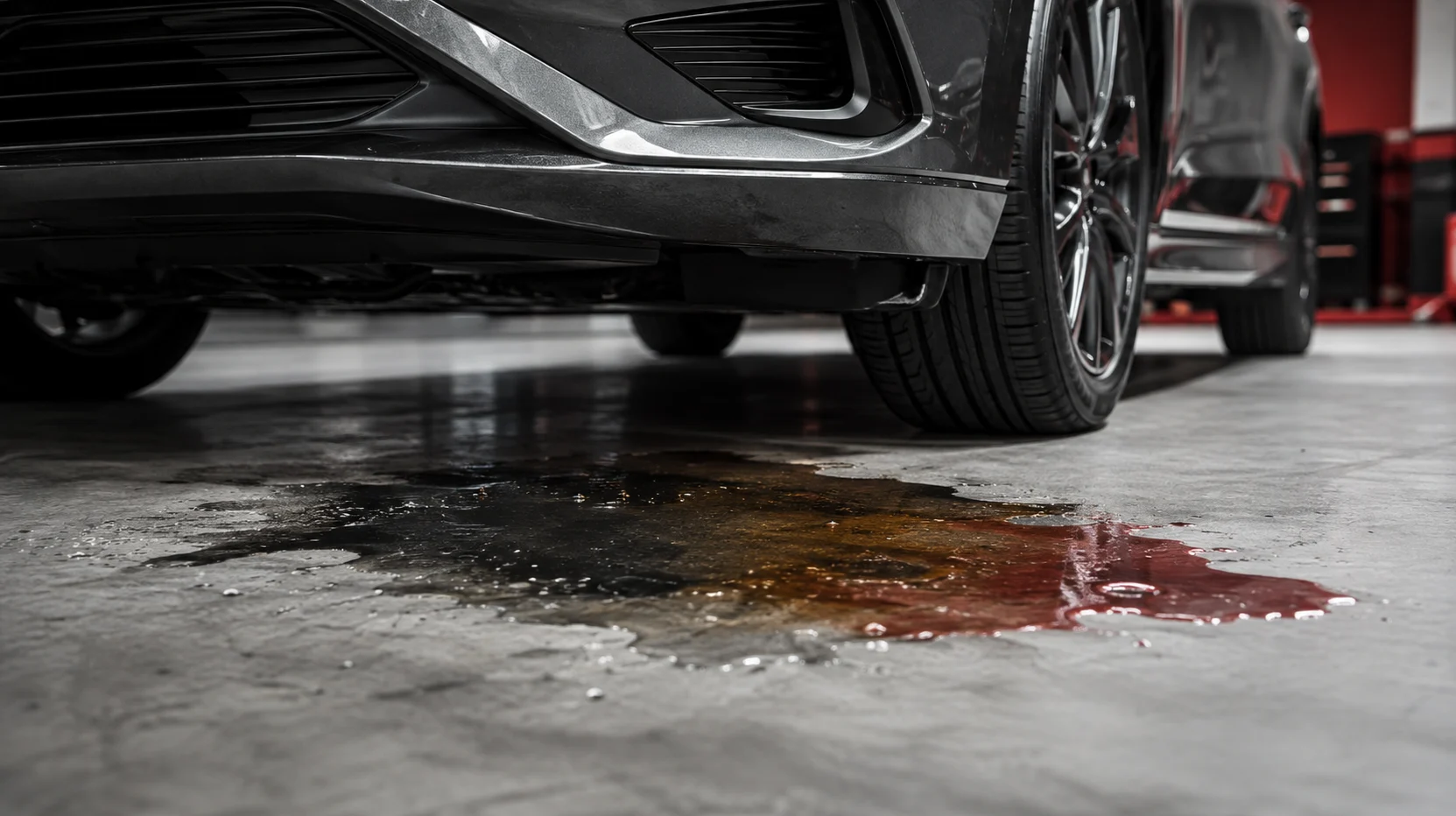
Colour
Clear, brown, black, red, pink, orange, green or blue can narrow things down, but modern fluids vary a lot.
Texture
Does it look watery, oily or thick? Just observe rather than handling an unknown automotive fluid if you do not need to.
Location
Note whether it sits under the front, around a wheel, beneath the centre of the car or farther towards the rear.
Timing
Did it show up after running the A/C, after a long drive, overnight, right after parking or after recent servicing?
What fluid could be leaking under your car?
Here are the most common possibilities. Think of this as a first-pass identification guide rather than a substitute for a proper inspection.
Clear water — often A/C condensation
If the puddle is clear, feels like ordinary water and shows up after the air conditioning has been running, it may simply be moisture draining from the A/C system. On a warm or humid day you can get more water than you expect.
Brown or black oily fluid — possible engine oil
Fresh engine oil can be amber or light brown, while used oil often turns much darker. A leak may come from a gasket, seal, oil filter area, sump, drain plug or another part of the lubrication system. The exact source matters: a small seep and a rapidly falling oil level are very different problems.
Pink, green, orange, red, blue or yellow fluid — possible coolant
Coolant is one of the easiest fluids to misidentify because there is no universal coolant colour. A leak can involve a hose, radiator, expansion tank, water pump, connection or another part of the cooling system. If the coolant level is falling, the temperature is climbing or steam appears, the problem needs immediate attention.
Red, pink or brown oily fluid — possible transmission fluid
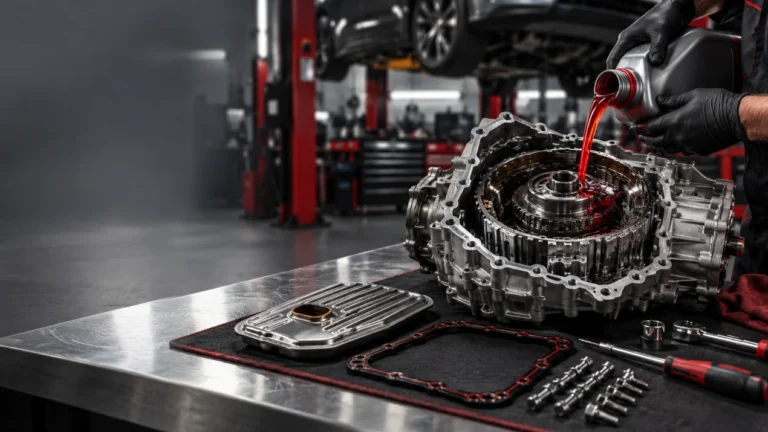
Automatic transmission fluid is often linked with a reddish colour, but you should not rely on that rule alone. Different transmissions use different fluids, and colour changes as fluid ages. A transmission leak may become more noticeable after driving when the system is hot.
Clear, pale yellow or amber fluid — possible brake fluid
This is one leak you should not casually watch for a week. Brake fluid is part of the hydraulic system that transfers your pedal input to the brakes. A leak may appear around a wheel, brake line or elsewhere in the system. If the brake pedal becomes soft, sinks, stopping performance changes or a brake warning appears, do not keep driving just to see whether it gets worse.
Red, amber or brown fluid — possible power steering fluid
Some vehicles use hydraulic power steering and can develop leaks from hoses, seals, the pump or steering rack. The fluid can look similar to transmission fluid because some systems actually use a specified type of ATF. Many newer cars use electric assistance instead, so there may be no hydraulic steering fluid at all.
Blue or coloured watery fluid — possibly washer fluid
Windscreen washer fluid can leak from the reservoir, pump, hose or connection. It is generally less mechanically serious than losing engine coolant, oil or brake fluid, but you still want the washer system working properly, especially before wet or dirty-road driving.
Clear or pale fluid with a strong fuel smell — possible petrol or diesel
A suspected fuel leak is not something to investigate by deliberately smelling the puddle or repeatedly starting the engine. Fuel leaks create a fire risk. Keep ignition sources away and arrange professional or roadside assistance rather than driving the vehicle.
Does where the puddle appears tell you anything?
It can help, but do not treat the puddle as a perfect map of the failed component. Fluid can run along covers, splash shields, crossmembers and other surfaces before it finally reaches the ground.
Front
Engine oil, coolant, washer fluid and some steering-system leaks may appear here.
Centre
A/C condensation and transmission/drivetrain fluids are among the possibilities, depending on vehicle layout.
Near a wheel / rear
Brake-system leaks deserve particular caution. Rear drivetrain or fuel-system leaks are also possible on some vehicles.
Can you still drive the car?
This is really the question that matters. A tiny wet mark and a car that behaves completely normally is one situation. A growing puddle plus a warning light, soft brake pedal or climbing temperature is another.
Likely A/C water
Clear, odourless water appears after using the air conditioning, the car behaves normally and no fluid levels or warning indicators have changed.
Unknown or recurring leak
You keep seeing an oily or coloured patch, a reservoir level is dropping, or the leak returns after you clean the area. Catching it early may stop a small seal or hose problem turning into a larger repair.
Safety or damage warning
Treat loss of braking, a soft or sinking brake pedal, overheating, steam, a major rapid leak, suspected fuel leakage, heavy steering or a serious warning message as a reason to stop somewhere safe and arrange assistance.
If the leak looks like coolant, watch the temperature, not just the puddle
A coolant leak can start quietly. Maybe you notice a few coloured drops overnight, or the reservoir seems lower than it was last week. Once there is not enough coolant circulating properly, though, the situation can change quickly.
If the temperature gauge climbs, an overheating warning appears or you see steam, move out of traffic safely and switch the engine off. Do not open the radiator cap or a pressurised cooling-system cap while the system is hot.
If overheating is part of what you are seeing, Servistar has a separate guide explaining what to do when your car is overheating . That guide goes deeper into radiators, hoses, cooling fans, thermostats and water pumps, so there is no need to diagnose all of those parts from the puddle alone.
If brake fluid is possible, be more cautious
Brake-fluid loss is different from discovering a little engine-oil seep. Your braking system depends on hydraulic pressure, so a fluid leak can eventually change how the pedal and brakes respond.
A suspicious leak around a wheel becomes much more concerning if the brake pedal feels softer than normal, travels farther, sinks under pressure, the car pulls when braking or a brake-system warning appears.
The sensible response is not to pump the pedal repeatedly and then head onto the motorway to “test it”. If braking does not feel normal, leave the car parked and arrange professional assistance.
If the leak is accompanied by squealing, grinding or other brake symptoms, see Servistar’s brake-noise guide for the other clues worth reporting to the workshop.
A simple check you can do without crawling under the car
If the vehicle is safely parked and there are no urgent warning signs, you can collect useful information without taking anything apart.
Take a photo before cleaning it.
Include something for scale if practical so you can tell whether tomorrow’s leak is larger or smaller.
Look at where the vehicle was parked.
Note whether the patch sits under the engine, near one wheel, around the centre or towards the rear.
Think about what happened immediately before it appeared.
Was the A/C running? Had the car just finished a long drive? Was it parked overnight? Has it recently been serviced?
Check the dashboard before driving.
Warning lights, a high temperature reading or an abnormal message can change the urgency completely.
Check accessible fluid levels only as your vehicle handbook recommends.
Do not open a hot cooling system, and do not use a random fluid simply because its colour looks similar.
Not sure what is leaking? Describe the symptom, not the repair.
You do not need to tell a workshop “I need a new radiator” or “my transmission seal has failed”. Tell them what you actually know: where the puddle appears, its colour, roughly how much there is, when it happens and whether the car is behaving differently.
Compare Repair OptionsWhat might a mechanic check?
The inspection should follow the evidence rather than replacing the first part that seems related. Depending on the fluid and vehicle, a workshop may clean the affected area, check fluid levels, inspect hoses and seals, look around components above the puddle and use system-specific tests to find the real source.
This matters because the place where fluid reaches the driveway is not necessarily where it started. Airflow while driving can move it backwards, and undertrays can collect fluid before releasing it somewhere else.
Help the workshop help you
Five details are usually more useful than guessing which part has failed.
- Where under the car does the puddle appear?
- What colour and consistency does it appear to have?
- How large is the patch and is it becoming worse?
- Does it happen hot, cold, overnight or after using the A/C?
- Have you noticed warning lights, smells, shifting changes, overheating, steering changes or different braking?
Three mistakes that can turn a small leak into a bigger problem
1. Repeatedly topping up the fluid without finding out why it is disappearing
A top-up may restore the level, but it does not repair a split hose, damaged seal or leaking component. If the level keeps falling, the leak still exists.
2. Buying fluid by colour
“Mine is red, so I need red transmission fluid” is not a safe way to choose a product. Vehicle manufacturers specify particular fluid types and standards. Use the owner’s manual or the correct vehicle-specific specification rather than trying to match what you see on the ground.
3. Waiting for the puddle to become large
Some leaks stay small for a long time. Others become dramatically worse once a hose splits further, a seal fails completely or the system becomes hot and pressurised. A recurring leak is worth investigating even when it has not yet produced a dramatic puddle.
Once the leak is diagnosed, compare the repair, not just the price
A quote for “fix fluid leak” does not tell you much. Ideally you want to understand where the leak was found, which component needs attention, what parts and labour are included, whether fluid replacement or bleeding is required, and whether another problem caused the leak in the first place.
If the repair is substantial, compare like with like. One workshop may be quoting a hose while another has included a damaged fitting, fluid replacement and additional testing.
Servistar’s guide to comparing mechanic quotes explains how to compare repair scope, parts, labour, diagnosis and warranty instead of choosing from the total price alone.
Frequently asked questions about fluid leaking under a car
Why is there clear water leaking under my car?
Clear water is often condensation draining from the air-conditioning system, particularly after the A/C has been running on a warm or humid day. If the liquid is coloured, oily, has an unusual smell, or is accompanied by warning lights or other symptoms, do not assume it is normal A/C water.
What does an engine oil leak under a car look like?
Engine oil usually feels slick and may range from amber or brown when relatively fresh to very dark brown or black after use. Dirt can alter its appearance. The puddle often appears around the engine area, but fluid can travel across underbody components before reaching the ground.
What colour is coolant when it leaks?
There is no single coolant colour. Depending on the product and vehicle it may be green, pink, red, orange, blue, yellow or another colour. That is why colour should be combined with location, fluid level and symptoms such as overheating or steam.
Is red fluid under my car always transmission fluid?
No. Many automatic transmission fluids are red when relatively fresh, but fluid specifications and colours differ. Some hydraulic power-steering systems also use reddish fluid. Proper identification should be based on the vehicle, location of the leak and inspection, not colour alone.
Can I drive with a small oil leak?
It depends on the source, rate of loss and oil level. A small seep is different from an active leak that is rapidly lowering the engine-oil level or reaching hot components. Check the level according to the vehicle handbook and arrange an inspection if the leak is recurring. If an oil-pressure warning appears, stop safely and seek assistance.
Can I drive with a coolant leak?
A coolant leak can lead to overheating once the level becomes too low or circulation is affected. If the temperature climbs, steam appears or an overheating warning is displayed, stop somewhere safe and switch the engine off. Never remove a hot radiator or pressurised coolant cap.
Can I drive if brake fluid is leaking?
A suspected brake-fluid leak should be treated seriously. If the brake pedal feels soft or sinks, braking performance has changed, a warning light appears or there is significant fluid loss, do not continue driving. Arrange roadside or professional assistance.
Why does my car only leak after driving?
Heat and system pressure can make some leaks more noticeable after a journey. Fluid may also collect on an undertray and drip after the vehicle stops. A/C condensation is another common reason a puddle appears only after driving with the climate system operating.
Why does the puddle appear in a different place from the leak?
Fluid can run across engine covers, undertrays, suspension members and other surfaces before reaching the ground. Airflow can move leaking fluid while the car is being driven as well. The position of the puddle is therefore useful evidence, but not proof of which component is leaking.
Should I tell the mechanic which fluid I think is leaking?
You can tell them what you observed, but avoid locking the diagnosis in too early. A description such as “dark oily drops under the front of the car after overnight parking” is often more useful than insisting that a particular seal or component has already failed.
A puddle is information. Use it early.
Finding fluid under your car is frustrating, but noticing it now is better than discovering the problem after a warning light, overheating episode or breakdown.
Take a photo. Note where it appeared. Pay attention to what the car is doing. And if the leak is more than normal A/C condensation, arrange an inspection before a small warning becomes an expensive surprise.
Need a workshop to take a look? Compare available car repair options through Servistar →
This article provides general information for Australian drivers and is not a vehicle-specific diagnosis. Fluid types, colours, reservoir locations and safe operating procedures vary between vehicles. Follow your manufacturer’s handbook and seek professional or roadside assistance whenever the vehicle may be unsafe to drive.