
That knock from the front of the car every time you cross a speed bump can sound expensive, but the noise alone doesn’t tell you which part has failed. Learn how to read the pattern, spot the warning signs and describe the problem clearly before comparing repair options.
You roll over a speed hump at walking pace and hear it: clunk. The next pothole does it again. On a smooth road the car may feel completely normal, which is exactly why this kind of noise is easy to put off, and hard to explain when you finally book it in.
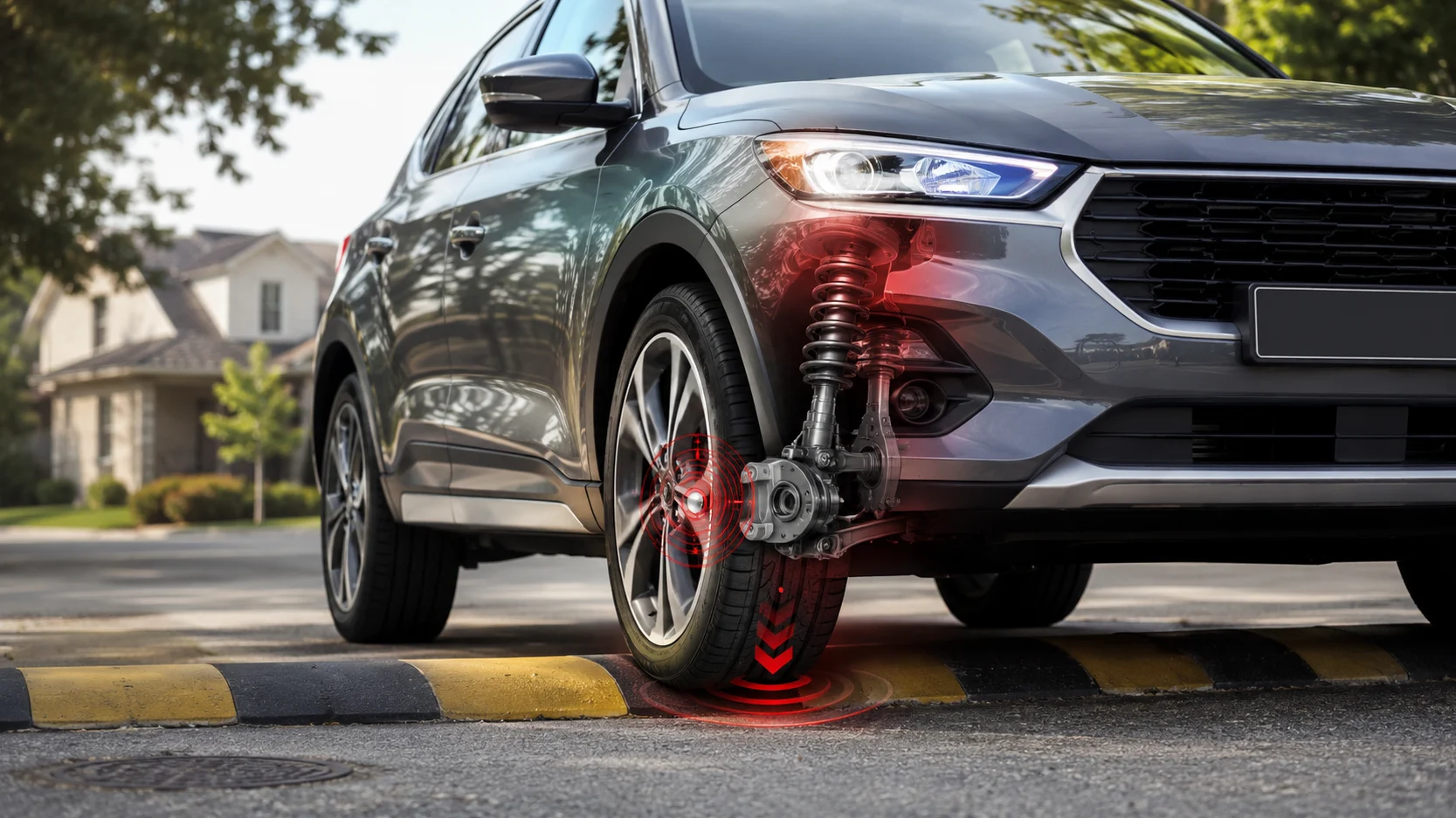
A knocking or clunking noise over bumps usually means something in the suspension, steering or nearby hardware is moving more than it should. That does not automatically mean the car needs new shock absorbers. Worn sway-bar links, bushes, ball joints, strut mounts, springs, loose mounts and even non-suspension hardware can all sound similar from the driver’s seat.
The most useful clues are when the noise happens, where it seems to come from, whether one wheel or both wheels trigger it, and whether steering, braking or tyre wear has changed. Use the sound to describe the problem, not to decide which part to replace before the car has been inspected.
Noise pattern decoderStart with the pattern: the same clunk can come from different places
Sound travels through a car’s body, subframe and floor, so location can be deceptive. A knock that seems to be under your feet may begin near a wheel. A rear noise can sound like it is in the boot. The smarter approach is to collect repeatable clues instead of trying to name the part too early.
Light, repetitive clunk or rattle
Sway-bar links and bushes are among the first items a workshop may consider, especially when the noise is most obvious at low speed over broken surfaces, driveway lips or patchy suburban roads.
The noise is clearer on diagonal driveways or uneven bumps
When the left and right wheels move differently, the anti-roll bar is loaded differently as well. That can make worn links or bushes easier to hear, although it is still only a clue, not a diagnosis.
Deeper knock or thud
The inspection may broaden to strut or shock mounts, dampers, springs, control-arm bushes and mounting hardware. Vehicle design matters, which is why the same sound can have a different source on a different car.
The car wanders, feels loose or also knocks while turning
Ball joints, tie-rod ends, top mounts and other steering or suspension pivots deserve more urgent attention because the symptom is no longer just a noise. Vehicle control may also be changing.
The knock appears as the car’s weight shifts
Control-arm bushes, suspension joints or brake hardware can sometimes move as load changes. Tell the mechanic whether the sound happens on the bump, while braking, or as you release the pedal.
The noise started after tyres, brakes or suspension repairs
Mention the timing. It does not prove the previous repair caused the noise, but wheel installation, recently disturbed hardware and components in the same area are sensible things for a workshop to rule out early.
If the car is smooth over bumps but shakes mainly when you press the brake pedal, read Servistar’s guide to car shaking when braking.
If the vibration appears at motorway speed on a smooth road, see why a car may shake at high speed.
Suspension & nearby hardwareSix common areas behind a clunking noise over bumps
There is no reliable “most likely part” for every vehicle. Suspension layouts differ, components wear at different rates, and more than one fault can exist at the same time. These are common areas a technician may investigate when road movement triggers the noise.
Sway-bar links and bushes
The anti-roll bar helps limit body roll. Its links and mounting bushes work constantly as the suspension moves. Wear can create play, producing a sharp knock or rattle over smaller bumps.
Control-arm bushes
These bushes allow controlled movement while helping locate the wheel. Cracking, separation or excess movement may produce a dull clunk as the suspension loads and unloads.
Ball joints and steering joints
Ball joints and tie-rod ends can develop play. A knock combined with vague steering, wandering, uneven tyre wear or a change in steering feel increases the urgency of an inspection.
Strut top mounts
The upper mount supports the strut and, on many front-suspension designs, also works with steering movement. Wear may cause a knock over bumps and sometimes a creak, pop or binding sensation while steering.
Shocks, struts or springs
A damper can wear internally, a mount can loosen or a spring can crack. Extra bouncing, fluid around a damper, changed ride height or a noise that worsens on larger bumps are useful supporting clues.
Loose hardware or something nearby
Not every under-car clunk is a suspension failure. Exhaust hangers, heat shields, underbody panels, spare-wheel hardware and loose items in the boot can imitate suspension noise.
Useful rule: sound alone is a poor parts catalogue. Several joints are loaded at the same time when a wheel hits a bump, so a worn sway-bar link, control-arm bush and strut mount can all be described as “a front-end clunk”. The value of the symptom is in narrowing the inspection, not naming the repair with certainty.
Decision guideIs it safe to drive with a knocking or clunking suspension?
Loudness is not a dependable measure of danger. A relatively harmless loose shield can be noisy, while wear in a steering or suspension joint may begin with a modest knock. What matters most is whether the car’s steering, braking, wheel position or stability has also changed.
Steering suddenly feels unsafe, the car wanders badly, a wheel sits at an unusual angle, braking behaviour changes, there is severe rubbing, or something appears loose or hanging underneath.
The clunk repeats over normal bumps, is getting worse, or comes with uneven tyre wear, new vibration, steering looseness or movement you can feel through the floor or wheel.
It happened once and the car otherwise feels normal. Remove loose cargo and check the spare-wheel area. If the new noise returns, arrange an inspection rather than monitoring it indefinitely.
Transport for NSW light-vehicle inspection standards require steering and suspension components and their mounting hardware to be secure and serviceable. That is one reason a new clunk deserves more attention when it arrives with a change in how the car steers or sits.
Got a repeatable clunk but do not know which repair to choose? Start with the symptom. Enter your vehicle and service details in Servistar and compare available repair or diagnostic options before you book.
Compare Repair OptionsSafe observationsSix useful checks before you call a mechanic
You do not need to identify the failed component yourself. A few safe observations can make an intermittent noise much easier for a workshop to reproduce.
Remove obvious loose items. Check the boot, spare-wheel area, jack and removable cargo. If the noise disappears, you may have found a very cheap cause.
Estimate the location. Front, rear, left or right is enough. “Seems front-left” is useful even if you are not certain.
Notice the road input. Small sharp joins, potholes, rough surfaces, driveway ramps and full-width speed humps move the suspension differently.
Compare one-wheel and two-wheel bumps. If safe during normal driving, notice whether a diagonal driveway triggers the sound more clearly than a full-width speed hump.
Pay attention to steering and braking. Note any new pulling, looseness, brake vibration or knock as you apply or release the brake.
Record the sound only if it can be done safely. A passenger can capture a short recording. Do not use a phone while driving or deliberately hit potholes to reproduce the noise.
Skip the driveway “shake test” unless you have the right equipment and knowledge. Do not crawl beneath a vehicle supported only by a jack, and do not lever suspension or steering joints simply to see what moves. Your safest DIY contribution is a clear description of the symptom pattern.
Inspection workflowWhat might a mechanic inspect?
A useful diagnosis normally begins by reproducing the complaint, then checking components that match the vehicle design and the way the noise occurs. Depending on what the technician finds, the inspection may include:
| Area | What the workshop may look for | Why it matters |
|---|---|---|
| Sway-bar links & bushes | Play, damaged boots, deteriorated bushes, insecure mounting | Small suspension movements can make worn joints knock repeatedly. |
| Control arms & bushes | Cracking, separation, excess movement, damaged mounts | These parts help locate the wheel as loads change. |
| Ball joints & tie-rod ends | Play, damaged boots, looseness, abnormal steering movement | Wear may affect steering control as well as noise. |
| Struts, shocks & top mounts | Leaks, loose mounts, wear, binding, damaged components | The fault may show up only during compression or rebound. |
| Springs | Cracks, breakage, poor seating, ride-height differences | A broken or displaced spring can knock and alter how the car sits. |
| Wheels, tyres & nearby hardware | Tyre or wheel damage, wheel security, shields, exhaust mounts, underbody panels | Not every bump-triggered sound starts in the suspension itself. |
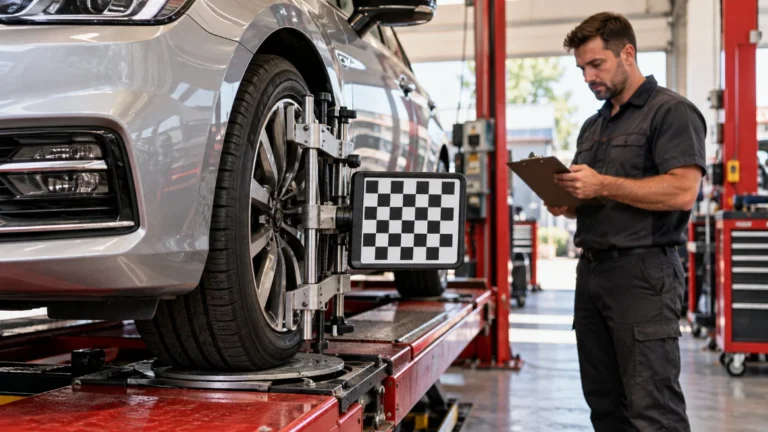
A wheel alignment may also be checked or recommended if the car pulls, tyre wear is uneven, a hard impact may have changed the geometry, or certain suspension parts are replaced. Alignment is not a generic cure for a clunk. It is a separate measurement that becomes relevant in the right circumstances.
Better quote requestsDescribe the symptom instead of the repair you guessed
Saying “I need front shocks” sounds precise, but it can steer the conversation toward a part that has not actually been confirmed. A short symptom description gives the workshop better information to work with.
“There is a clunk from the front-left at low speed over small bumps. It started this week. I can also hear one knock when I come off the brake, but the steering still feels normal.”
- Where does the sound seem to come from?
- Which bumps trigger it?
- Is it worse while turning, braking or releasing the brake?
- Did it begin after a pothole, tyre change or recent repair?
- Has steering, braking, ride height or tyre wear changed?
Once the vehicle has been inspected, compare the scope of work before comparing the final price. Ask which component has actually failed, whether the quote covers one side or both, whether related hardware is included, whether an alignment is required afterwards, and what warranty applies.
If two workshops describe the repair differently, Servistar’s guide to comparing mechanic quotes explains how to check whether you are genuinely comparing the same job.
Road impact contextWhat if the noise started after a pothole or hard road impact?
A pothole or sharp road edge can be the moment you first notice a problem, but timing alone does not prove that one impact created all the wear. Bushes, links and joints deteriorate over time, and a hard bump may simply make existing play easier to hear.
If the clunk began immediately after a significant impact, tell the workshop. It may need to inspect more than the noisy joint, including the tyre, wheel, alignment and surrounding suspension. A tyre bulge, visible wheel damage, severe pulling or a car that no longer feels stable should be treated as more than an annoying noise.
FAQCommon questions about knocking and clunking over bumps
Why does my car make a knocking noise over bumps but drive fine on smooth roads?
Bumps make the suspension compress and rebound quickly. If a bush, joint, link, mount or nearby component has developed play, that extra movement can produce a knock even when the car feels normal on a flat road.
What causes a front-end clunk over small bumps at low speed?
Sway-bar links and bushes are common possibilities, but control-arm bushes, strut mounts, steering joints and loose hardware can sound similar. Location and whether steering or braking changes the noise help narrow the inspection.
Can worn shock absorbers make a knocking noise?
Yes. A worn damper, damaged mount or loose mounting point can make noise as the suspension moves. But a knock near the shock absorber does not prove the damper itself has failed because mounts, links and bushes nearby may produce a similar sound.
Why does my car clunk over bumps and when turning?
When steering movement also triggers the noise, a workshop may inspect strut top mounts, ball joints, tie-rod ends and other steering or suspension joints. Clicking on full steering lock can suggest a different issue, such as a CV joint, so describe the sound and timing carefully.
Can a control-arm bush cause a clunk when braking?
It can. Braking shifts load through the suspension, so excess movement in a control-arm bush or another joint can become noticeable as a knock. Brake hardware can also move as load changes, which is why the source needs to be confirmed.
Does a clunk over bumps mean I need new suspension?
No. “Suspension” includes many separate components, and the cause may be a link, bush, mount, joint, damper, spring or non-suspension hardware nearby. Ask for the failed component to be identified before approving broad replacement work.
Should I get a wheel alignment for a knocking noise?
Not automatically. Alignment adjusts wheel angles. It does not repair a loose joint or worn bush. It may be appropriate when the vehicle pulls, tyres wear unevenly, impact damage has affected geometry, or certain suspension components have been replaced.
How long can I drive with a suspension clunk?
There is no reliable distance because the cause and severity are unknown. A repeatable new noise should be inspected. If steering or braking changes, the car becomes unstable, a wheel sits abnormally or something is visibly loose, stop driving when safe and arrange assistance.
Do not choose a suspension part from the sound alone.
Describe what the car is doing, enter your vehicle and location details, and use Servistar to compare available service or repair options. The workshop can then inspect the car and confirm what actually needs attention.
General information for Australian drivers. Individual vehicle designs and repair requirements vary. Safety context: Transport for NSW Light Vehicle Safety Check Standards. A physical inspection is required to confirm the cause of a specific vehicle noise.